

Finding the right keywords is one of the first steps towards growing organic traffic. AI SEO tools help businesses discover relevant search terms, understand user intent, analyse competitors and plan content more efficiently.
However, choosing keywords is only part of SEO. Sustainable White Label SEO Audit Tool growth also depends on useful content, technical performance, relevant links and a good user experience.
This guide compares tools by their practical uses and explains how to turn keyword research into a clear content strategy.
Quick answer: Which AI SEO tools should you use?
The right tool depends on your goals, budget and existing SEO workflow.
| Tool | Main use |
| Semrush | Keyword discovery and competitor research |
| Ahrefs | Keyword metrics and backlink analysis |
| Google Keyword Planner | Search demand and advertising keyword ideas |
| Google Search Console | Finding opportunities from your website’s real search performance |
| Surfer SEO | Content briefs and on-page optimisation |
| LowFruits | Exploring potentially less competitive search results |
| ChatGPT | Brainstorming, keyword grouping and content planning |
These tools have different strengths. Some provide SEO databases and measurable search metrics, while others help organise research and improve content workflows.
What are AI SEO tools?
AI SEO tools are software applications that use artificial intelligence, machine learning or language models to assist with search engine optimisation.
Depending on the product, they can help with:
- Discovering long-tail and related keywords.
- Grouping keywords by topic and search intent.
- Analysing search results and competing pages.
- Creating content briefs and topic outlines.
- Identifying on-page and technical SEO issues.
- Monitoring rankings, traffic and AI search visibility.
Important distinction: AI-generated keyword suggestions are not the same as verified search-volume data. Always check important keywords against SEO metrics and actual search results.
7 AI SEO tools for keyword research and organic growth
1. Semrush: Keyword discovery and competitor analysis
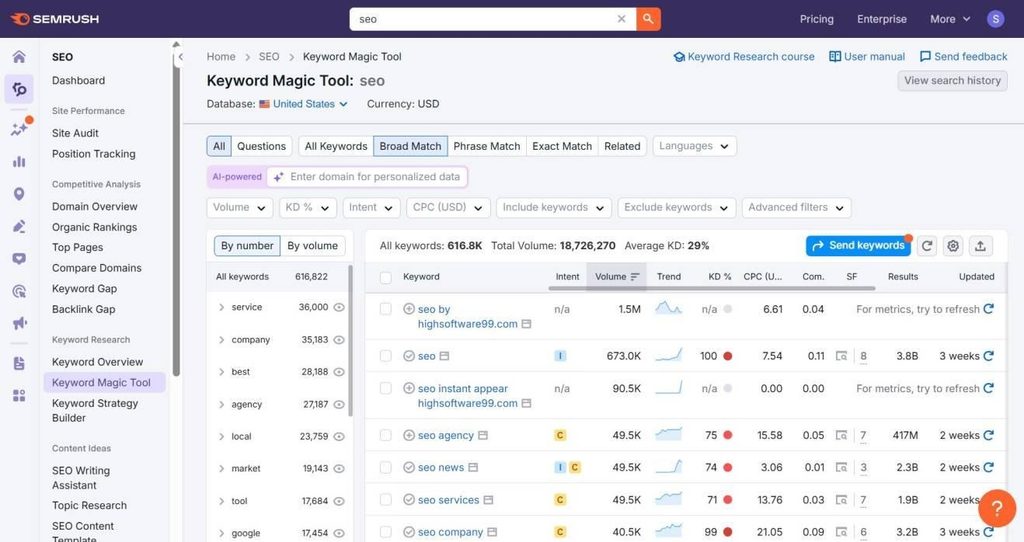
Semrush combines keyword research with competitive analysis, site auditing and content optimisation. Its Keyword Magic Tool helps expand a seed keyword into related search terms.
Useful for:
- Finding related and long-tail keywords.
- Reviewing search volume, keyword difficulty and search intent.
- Identifying keyword gaps between your website and competitors.
- Building topic clusters for content planning.
Practical example: A digital marketing agency targeting “SEO services” could investigate related searches such as local SEO services, technical SEO audits and SEO services for small businesses.
This helps the agency build a relevant content plan rather than relying on one broad keyword.
Limitation: The breadth of features can be overwhelming for beginners, and paid plans may be expensive for small websites.
2. Ahrefs: Keyword metrics and competitor research
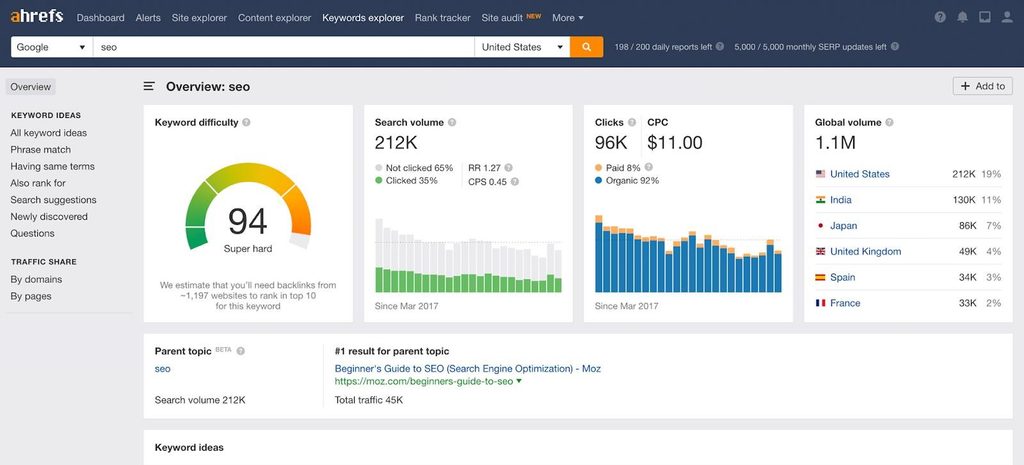
Ahrefs is widely used for keyword research, backlink analysis and competitor investigation. Keywords Explorer provides metrics and related keyword ideas, while its competitive tools help identify content opportunities.
Useful for:
- Exploring related search terms.
- Evaluating keyword difficulty and traffic potential.
- Analysing competing pages and backlinks.
- Finding keywords competitors rank for that your website does not.
Expert insight: Search volume alone can be misleading. A keyword with lower volume may attract more relevant visitors if its intent closely matches your service or product.
Limitation: Advanced research features require a paid plan, and keyword difficulty is an estimate rather than a ranking guarantee.
3. Google Keyword Planner: Search demand research
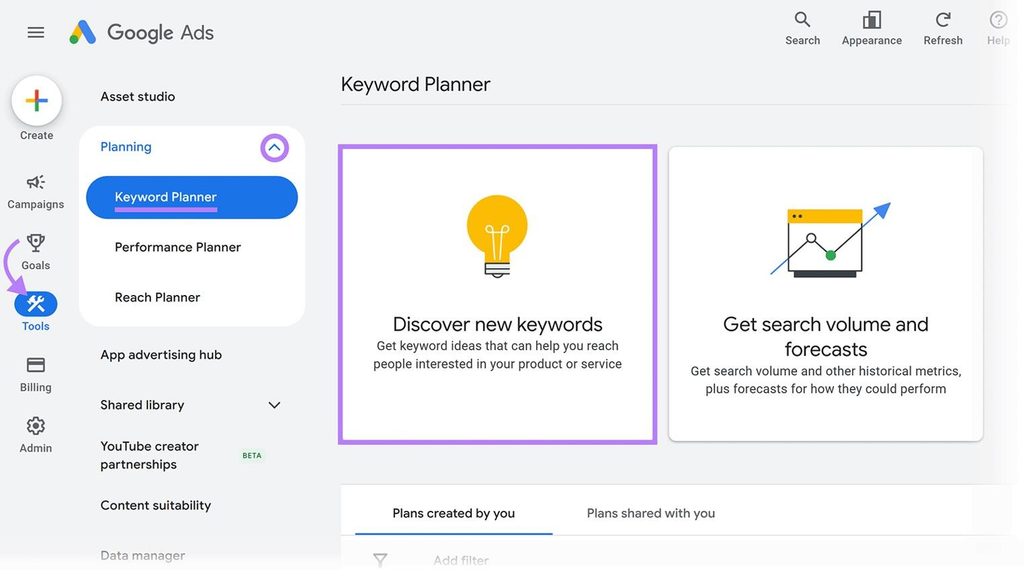
Google Keyword Planner is a useful starting point for researching search terms and estimated search demand. It is designed for Google Ads, but its keyword ideas can also support organic SEO planning.
Useful for:
- Discovering keyword variations.
- Exploring estimated search volumes and trends.
- Researching commercial terms.
- Investigating location-specific searches in the UK or USA.
For example, a business can compare location-focused phrases such as “digital marketing agency London” and “digital marketing agency New York”.
Limitation: It is not a complete organic SEO platform. Search-volume ranges and advertising metrics should not be treated as exact organic traffic forecasts.
4. Google Search Console: Real website search data
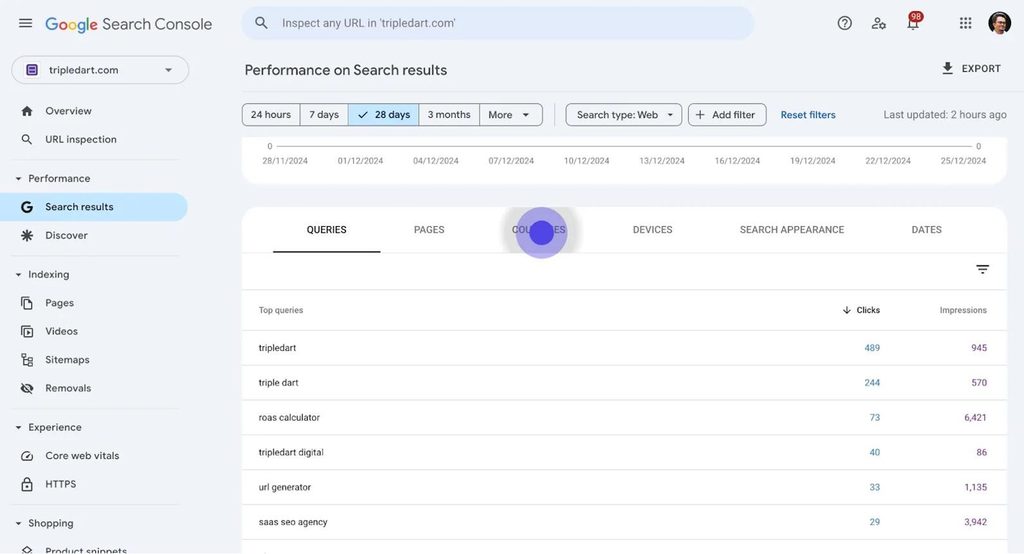
Google Search Console is particularly useful once your website has started appearing in Google Search.
It shows how your pages perform through impressions, clicks, click-through rate and average position.
Useful for:
- Finding queries that already generate impressions.
- Identifying pages with visibility but relatively few clicks.
- Tracking changes in organic search performance.
- Discovering related queries worth covering in existing content.
Practical example: If a page receives impressions for “technical SEO checklist for ecommerce”, but the page only covers general website audits, you could assess whether adding a relevant ecommerce section would genuinely help users.
Limitation: Search Console reports your site’s performance. It is not a full competitor keyword database or an AI keyword generator.
5. Surfer SEO: Content optimisation
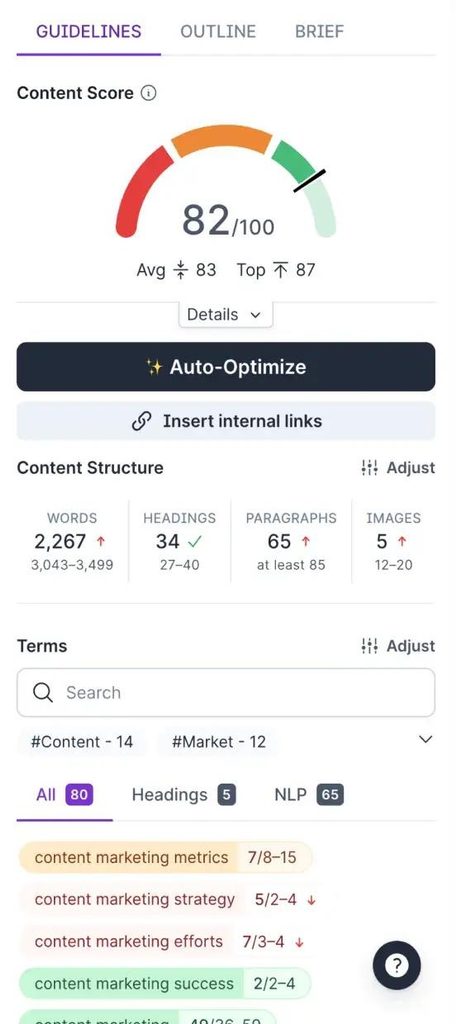
Surfer SEO focuses on content research and on-page optimisation. It can help writers examine search results, develop content briefs and review how well a draft covers relevant topics.
Useful for:
- Creating structured content briefs.
- Identifying related terms and subtopics.
- Reviewing headings and topical coverage.
- Supporting consistent content workflows.
Expert insight: Use optimisation recommendations as guidance, not a rigid formula. Adding unnecessary keywords to achieve a higher content score can make an article less helpful.
Limitation: Content scores do not measure every factor Google uses to rank a page.
6. LowFruits: Exploring less competitive keywords
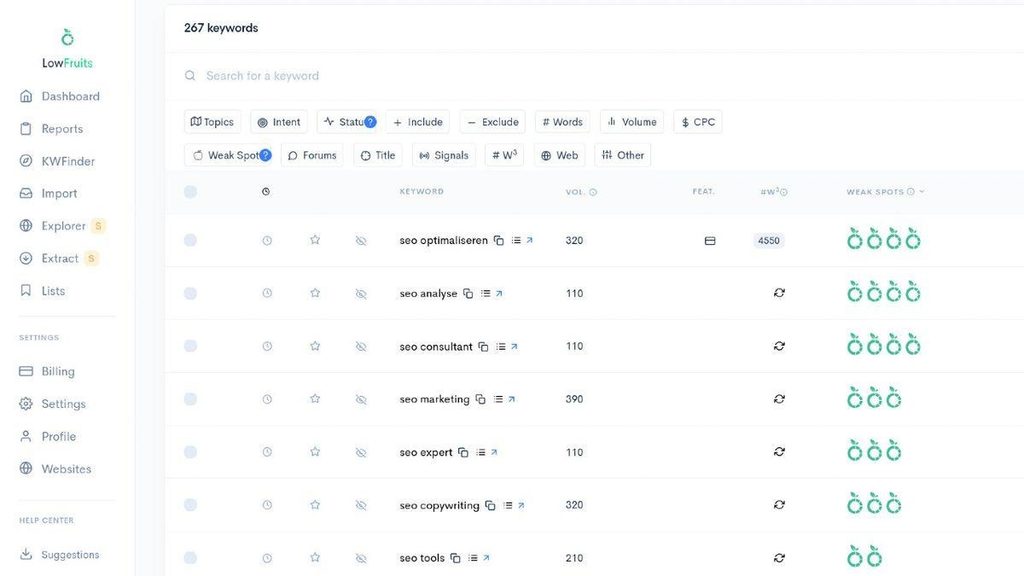
LowFruits focuses on finding keyword opportunities where the search results may contain weaker or less specialised competing pages.
This can be useful for smaller websites that need to choose topics carefully.
Useful for:
- Discovering long-tail keyword ideas.
- Examining the strength and relevance of ranking pages.
- Finding specific questions and niche topics.
- Prioritising content opportunities for smaller websites.
Limitation: A weak-looking competitor does not guarantee that your page will rank. Search intent, content quality, authority and competition still matter.
7. ChatGPT: Keyword clustering and content planning
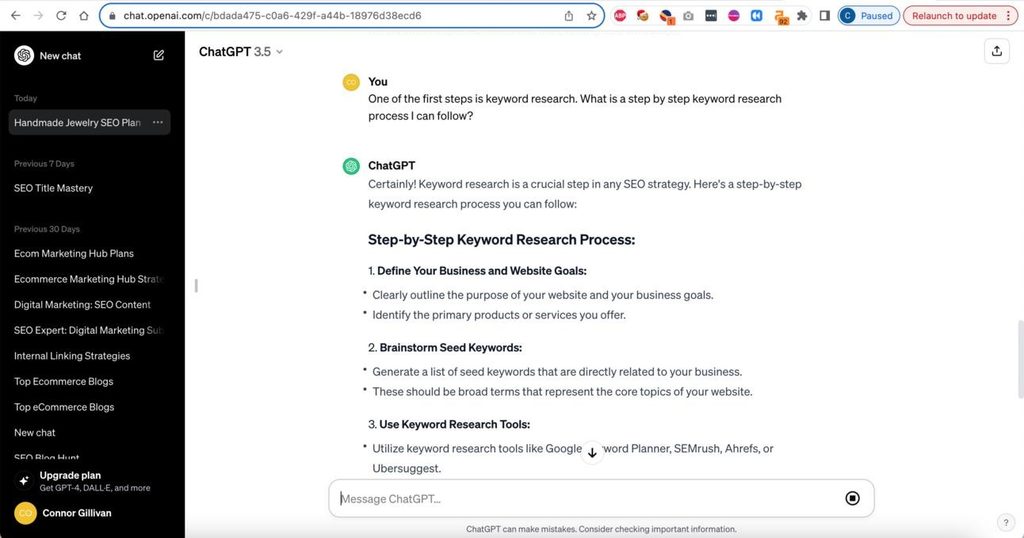
ChatGPT can support the research and planning stages of SEO. It is particularly useful for organising keyword lists, brainstorming related topics and turning research into content briefs.
Useful for:
- Grouping supplied keywords by search intent.
- Generating related questions and topic ideas.
- Creating outlines and editorial calendars.
- Summarising competitor content that you provide.
- Suggesting internal-link opportunities.
Example prompt:
Group these keywords by search intent. Identify which terms belong on the same page, which need separate pages, and what information each page should cover. Do not invent search-volume or keyword-difficulty data.
Limitation: ChatGPT may generate inaccurate metrics or plausible-sounding keyword ideas that have little actual demand. Validate suggestions using reliable SEO data and live search results.
What top-ranking competitor content covers, and what it often misses
I reviewed the search results available for this topic across UK-focused and broader English-language results, including tool comparisons, keyword research guides and agency-focused articles.
Research limitation: I could not verify the complete contents of five consistently ranking pages in both the UK and USA. Search results can also vary by location, device and date. The following is a qualitative content-gap analysis of the accessible results, not a verified ranking-position study or a claim that every competitor misses these points.
Common themes in the competing articles
| Content theme | What the accessible articles cover |
| Tool comparisons | Features, use cases and pricing |
| Keyword discovery | Related terms, search volume and keyword difficulty |
| AI capabilities | Clustering, content assistance and intent classification |
| Audience needs | Agencies, bloggers, businesses and content teams |
| AI search | Visibility in AI-generated answers and search experiences |
For example, TechnologyAdvice’s 2026 guide covers established SEO platforms and AI visibility, while UK agency-focused articles discuss content optimisation, technical SEO and local SEO.
Content gaps worth addressing
1. A practical workflow, not just a tool list
Explain how to move from a seed keyword to validated keywords, a content brief, publication and performance tracking.
2. Clear separation of AI ideas and real SEO data
Help readers understand why generated keyword suggestions need validation against search metrics and live results.
3. A realistic approach for small businesses
Explain how free tools and existing website data can help people start without buying several expensive subscriptions.
4. UK and US search intent
Highlight local spelling, locations, customer needs and differences in search results instead of assuming one keyword strategy fits both markets.
5. Measuring actual growth
Connect keyword research to relevant clicks, conversions, qualified leads and content performance, rather than treating rankings as the only outcome.
The competitor results also discuss low-competition opportunities, AI-assisted clustering and the importance of looking beyond search volume.
The article above incorporates these themes into its tool descriptions and practical examples.
How to use AI SEO tools for faster keyword research
A repeatable workflow can make keyword research easier to manage without sacrificing accuracy.
- Start with a business topic
Choose a product, service or problem your audience wants to solve. For example, “technical SEO”. - Generate keyword ideas
Use Semrush, Ahrefs, Keyword Planner or ChatGPT to discover related phrases, questions and long-tail searches. - Validate search demand
Check available volume, competition metrics and current search results. Do not assume every AI-generated suggestion has meaningful demand. - Classify search intent
Separate informational searches, commercial investigation, transactional searches and navigational queries. - Group keywords into useful pages
Combine terms when they share the same search intent and can be answered well by one page. Create separate pages when the user needs a different solution. - Publish and measure
Create genuinely useful content, add relevant internal links, and use Google Search Console to review impressions, clicks and changes in performance.
Example: Turning one keyword into a content cluster
Seed keyword
Technical SEO
Informational
What is technical SEO?
Technical SEO checklist
Commercial
Technical SEO audit services
Technical SEO tools
Specific needs
Technical SEO for ecommerce
Transactional
Hire a technical SEO consultant
Illustrative keyword ideas. Validate actual demand and whether the terms deserve separate pages.
This approach helps build topical coverage while reducing the risk of creating multiple pages that compete for the same search intent.
How to choose the right tool for your needs
Rather than purchasing every platform, identify the main problem in your SEO workflow.
| Your situation | Tools to consider |
| Starting with a limited budget | Google Keyword Planner, Search Console and ChatGPT |
| Researching competitors | Semrush or Ahrefs |
| Finding potential niche opportunities | LowFruits |
| Improving existing content | Surfer SEO and Search Console |
| Managing an agency’s SEO workflow | Semrush or Ahrefs, with additional tools where needed |
These are use-case suggestions, not a universal ranking. Compare current plan limits, data coverage and pricing before subscribing.
Making content more useful for Google AI Overviews and answer engines
AI search visibility is not achieved simply by adding keywords or inserting an FAQ section.
Create content that directly answers real questions and supports its claims with trustworthy information.
Practical optimisation principles
- Put a clear definition or direct answer near the beginning of relevant sections.
- Use descriptive headings that reflect real user questions and needs.
- Include examples, comparisons and meaningful original insights.
- Explain technical concepts in straightforward language.
- Support factual claims with reliable, relevant sources.
- Keep important information accessible in the page’s main content.
- Review outdated statistics, product features and recommendations.
For AEO and GEO, the goal is to make content easy to understand, useful to readers and clear about where its information comes from. No particular format guarantees citation by an AI search engine.
Does schema markup guarantee AI visibility?
No. Structured data can help search engines interpret page information, but it does not guarantee rankings, rich results or inclusion in AI-generated answers.
Use valid schema that accurately represents the content on the page. Do not add FAQ or HowTo markup simply to target an AI feature.
Conclusion
AI SEO tools can make keyword research faster and more organised, but meaningful growth comes from using their insights well.
Start by understanding your audience, validate keyword suggestions with reliable data, group related searches by intent and create content that genuinely answers users’ questions.
Use Google Search Console to monitor performance and improve your strategy over time. Whether you choose Semrush, Ahrefs, Surfer SEO, LowFruits or ChatGPT, focus on the tools that solve your actual SEO problems.
The objective is not to collect the largest keyword list. It is to attract the right audience with useful content and turn relevant search visibility into sustainable business growth.
Frequently asked questions
What are the best AI SEO tools for keyword research?
Semrush and Ahrefs offer extensive keyword and competitor research features. Google Keyword Planner and Search Console provide useful search data, while ChatGPT can help organise keyword ideas and content plans.
The right choice depends on your budget and research needs.
Can AI SEO tools help improve Google rankings?
Yes, they can support keyword research, content optimisation and technical SEO workflows. However, rankings depend on many factors, including relevance, competition, content quality and website performance. No tool guarantees a ranking.
Are there free AI SEO tools?
Yes. Google Keyword Planner and Google Search Console offer free access to useful SEO-related data. ChatGPT also has free access options, subject to current usage limits. Some dedicated SEO platforms provide limited free tools or trials.
How do AI SEO tools find low-competition keywords?
They may analyse keyword difficulty, competing pages, search results and related terms to identify potential opportunities. These metrics are estimates, so review the actual search results before deciding whether a keyword is worth targeting.
Can AI SEO tools help with Google AI Overviews?
They can help you research questions, improve content structure and monitor certain aspects of AI search visibility. However, using AI SEO tools does not guarantee that Google will select your content for an AI Overview.