

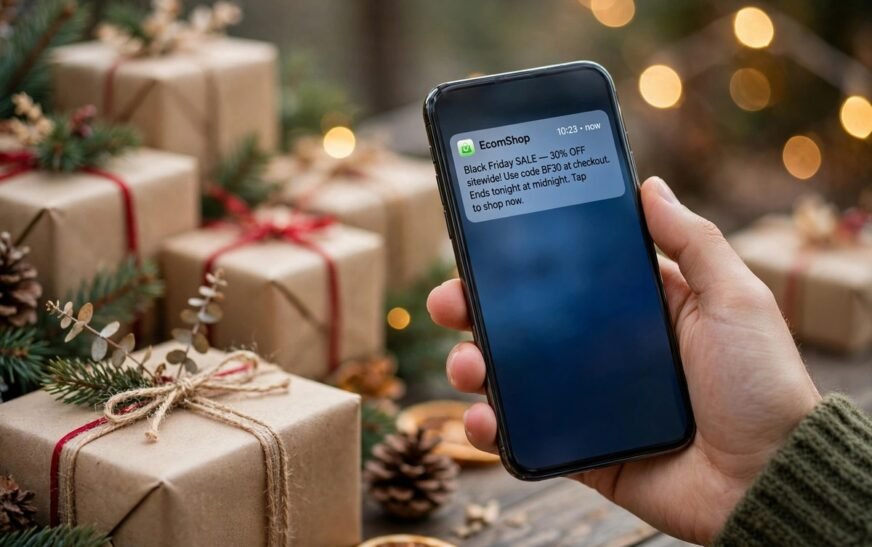
SMS marketing for Black Friday ecommerce works when the text feels like a favour, not an interruption. A shopper who opted in for early access wants to know the moment the sale opens. A shopper who never asked for texts and gets four in one day will mute you, and probably unsubscribe from your email too. The difference is not the discount. It is the timing, the targeting and the wording. This guide covers all three, with real platform prices, a send calendar for Black Friday week 2026, copy-ready messages, and the UK and US rules that decide whether you can legally press send at all.
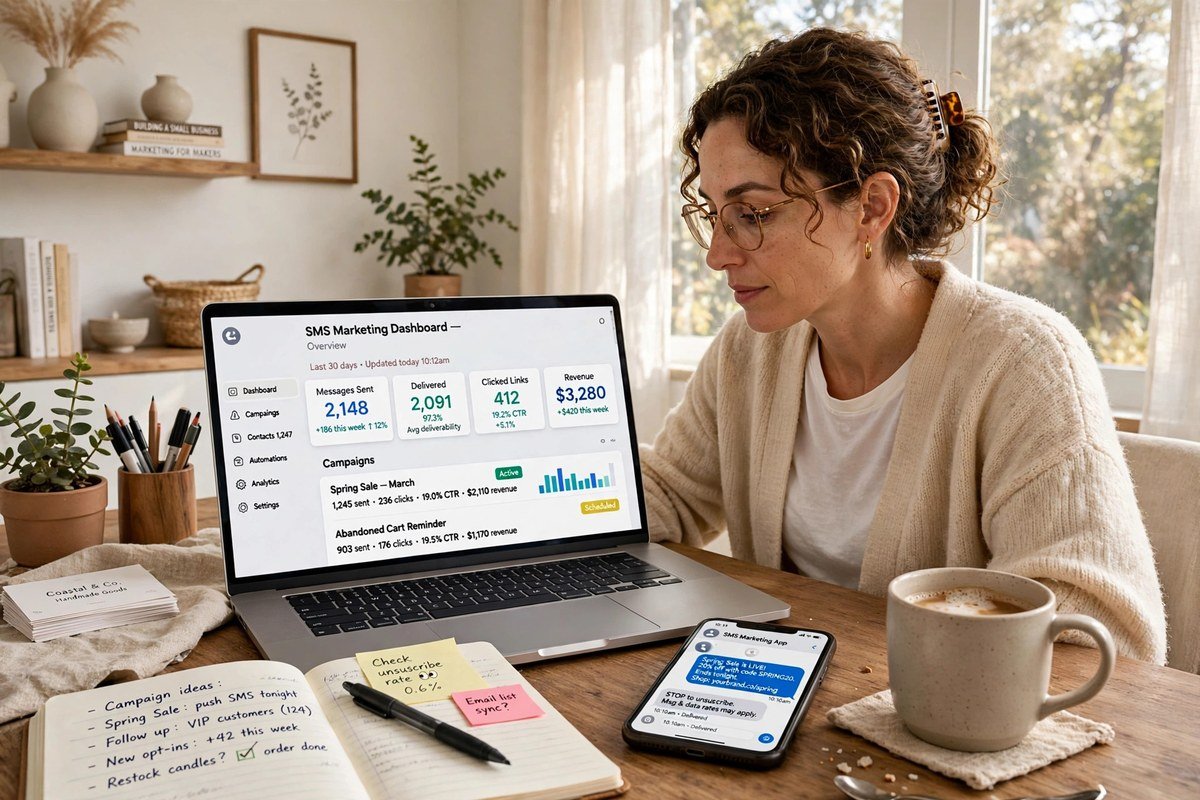
Why Does SMS Work So Well on Black Friday?
Black Friday is a phone-first event. Adobe measured $11.8 billion in US online spending on Black Friday 2025 and $14.25 billion on Cyber Monday, with $44.2 billion across the five days of Cyber Week. The National Retail Federation counted 85.7 million online shoppers on Black Friday 2025 alone, and Adobe reports that 57.5% of Cyber Monday 2025 online sales came through a mobile device. Your texts land on the same device where the buying happens.
SMS also cuts through a crowded week better than email. Klaviyo’s SMS benchmarks put the average SMS click rate at around 6%, with top-performing brands reaching close to 15%. Its consumer research with Recharge found that 72% of consumers say brands should send text messages at least once a week, and the same proportion have made a purchase after receiving a text from a brand. Email still does the heavy work of merchandising, which is why our Black Friday email marketing campaign checklist pairs with this guide, but SMS is the channel for the moment that needs an immediate answer: the sale is live, the window closes in two hours, the size is back in stock.
How Much Does SMS Marketing for Black Friday Ecommerce Cost?
Budget before you write a single message. SMS is priced per segment, and the cost multiplies across your list and your send calendar. A standard text holds 160 characters on the GSM-7 character set. Go over 160 characters, or add an emoji or an accented character, and the message splits into two billable segments. With emoji, a single segment holds only 70 characters. Short messages are not just better writing on Black Friday, they are literally cheaper.
| Platform | Starting price | US SMS cost | Best for |
|---|---|---|---|
| Klaviyo | $15 a month for 1,250 SMS credits; free plan includes 150 credits | About $0.009 per SMS at volume; 1 credit per US SMS, 3 per MMS | Email and SMS in one place |
| Postscript | $0 a month with a $49 monthly minimum spend | $0.009 per SMS plus carrier fees averaging $0.00330, about $0.0123 all in | Shopify stores that want an SMS specialist |
| Omnisend | Pro plan from $59 a month; SMS is Pro-only for new accounts since May 2026 | From $0.009 per SMS, falling to $0.007 at high volume | Email, SMS and push together |
| Attentive | Quote only, usually with an annual commitment | Not published | Larger brands with a dedicated SMS budget |
| Twilio | Pay as you go, no monthly fee | $0.0083 per segment plus carrier fees of $0.0035 to $0.005; UK sends cost $0.056 per segment | Developers building their own flows |
Work out the full week before you commit. A store with 5,000 SMS subscribers sending four planned messages sends 20,000 messages. On Klaviyo that costs about $180 at the $0.009 per credit rate. On Postscript Starter it costs about $246 all in, at $0.0123 per message, and the $49 minimum spend is already covered. UK stores should budget more: a Twilio text to a UK number costs $0.056 per segment, more than six times the US rate. Two traps catch first-time senders. MMS costs roughly three times a plain SMS on Klaviyo, and $0.045 per message on Postscript Starter against $0.009 for SMS. A 200-character launch text with one emoji can bill as three segments, so keep launch messages under 160 characters and save images for email.
How Many Texts Should You Send, and When?
Four to six planned messages across the whole week is the right range for most stores. Fewer and the list forgets you exist; more and opt-outs climb. The calendar below uses the real 2026 dates. Black Friday is Friday 27 November, Cyber Monday is Monday 30 November, and Thanksgiving falls on Thursday 26 November. Every send has one audience and one job, and nobody should receive all of them.
| Date | Send | Audience | Purpose |
|---|---|---|---|
| Mon 16 to Thu 19 Nov | Text-to-join push, then a teaser with sale dates | Visitors, then engaged subscribers | Grow the list, then give a reason to watch for the next text |
| Mon 23 to Wed 25 Nov | Early access opens, plus one reminder before it closes | VIP and loyalty members only | Reward the best customers first |
| Thu 26 Nov | Nothing, or one short message at most | Everyone | Thanksgiving is not a selling day for most stores |
| Fri 27 Nov, 6 to 9am local | Launch: the sale is live | All opted-in subscribers | Announce the offer and link to the sale collection |
| Fri 27 Nov, midday | Flash sale or bundle, 2 to 6 hour window | Non-buyers who clicked the launch | Create a second reason to act |
| Fri 27 Nov, evening | Last chance, 2 to 4 hours before close | Subscribers who clicked but did not buy | Close the day with a real deadline |
| Sat 28 to Sun 29 Nov | Selective follow-ups only | Cart abandoners and category browsers | Help, do not nag |
| Mon 30 Nov | Cyber Monday launch in the morning, final last chance in the evening | All subscribers, then non-buyers only | New offer or extended deadline, clearly stated |
Send in the subscriber’s local time zone, never your own. A launch text scheduled for midnight Eastern lands at 9pm Pacific, and a 7am Pacific send lands at 10am Eastern. Klaviyo’s 2024 data recorded its highest Black Friday send volume between 9 and 10am Eastern, while order volume peaked from noon to 1pm Eastern, which supports a morning launch with the buying peak a few hours later. Coordinate with your other channels so SMS and email do not repeat each other: email explains the offer, SMS flags the deadline. Shoppers who received both email and text from a brand during BFCM 2025 placed 11% more orders than shoppers reached through one channel alone, according to Klaviyo’s BFCM recap. Our Black Friday paid social ads strategy covers the paid side of the same week.
Which Messages Do Customers Welcome, and Which Get Muted?
Welcome messages share three traits: they name the brand first, they state the offer and the deadline in the same breath, and they link to the exact collection, not the homepage. Muted messages do the opposite: vague offers, no deadline, a homepage link, and a second text two hours later saying the same thing. The examples below are written for a fictional homeware store, Willow and Oak, so you can see finished copy instead of placeholders. Swap in your brand, your offer and your link. Every message fits inside one 160-character segment.
Early access, sent Monday 23 November:
Willow and Oak: your Black Friday early access is open. 25% off winter bedding until Wed 25 Nov, 9pm. Shop: willowandoak.co.uk/bf Reply STOP to opt out
Launch, sent Friday 27 November at 8am:
Willow and Oak: Black Friday is live. 30% off winter bedding, today only. Shop the sale: willowandoak.co.uk/bf Reply STOP to opt out
Flash sale, sent Friday 27 November at midday for a three-hour window:
FLASH: 40% off throws and cushions until 3pm today only at Willow and Oak. Shop: willowandoak.co.uk/flash Reply STOP to opt out
Last chance, sent Friday 27 November in the evening:
Last chance: 30% off at Willow and Oak ends tonight at 11:59pm. Shop before prices rise: willowandoak.co.uk/bf Reply STOP to opt out
Cart recovery, sent Saturday 28 November to shoppers who left checkout:
Willow and Oak: your basket is still waiting, and 30% off ends Monday. Finish your order: willowandoak.co.uk/cart Reply STOP to opt out
Three writing rules sit behind all five. Put the brand name first, because an unknown number gets deleted unread. Put the deadline in the message, not only on the landing page: “until Wed 25 Nov, 9pm” beats “for a limited time”. And never invent urgency. A low-stock warning is only honest when stock is actually low, and a “last chance” that repeats on Monday teaches subscribers that your deadlines mean nothing.
How Do You Segment the List So the Right People Get the Right Text?
Sending the same message to everyone is the most common reason Black Friday SMS campaigns underperform. A VIP who bought three times this year does not need the same text as someone who signed up two days ago. Build six segments before Black Friday week, each with a rule you can explain: VIPs (two or more orders) get early access first; recent buyers (last 30 days) get order updates, not discount reminders; engaged non-buyers (clicked in the last 90 days, no order) get the launch and last chance; cart abandoners (left checkout in the last 7 days) get one recovery text; category browsers (viewed a category twice or more) get a deal on that category; lapsed customers (no purchase in 6 months or more) get one strong reason to return, then silence if they do not engage.
Exclusions matter as much as inclusions. Before every send, remove anyone who bought the item you are promoting, anyone who opted out, anyone with an open support complaint, and anyone who already received a flow message about the same offer that day. A shopper who bought on Friday morning does not need a last-chance text on Friday evening, and a shopper waiting for an answer about a failed discount code needs that answer, not another sales nudge.
What Are the Rules? TCPA, GDPR and PECR in Plain Terms
Compliance is not a footnote for Black Friday SMS, because the fines and the carrier blocks are real, and sale week is when teams are most tempted to cut corners. The rules differ by country, so apply the ones that cover your subscribers, not just your store.
In the United States, the Telephone Consumer Protection Act requires express written consent before you send marketing texts, and consent for one channel does not transfer to another: email consent does not authorise SMS. Federal rules bar telephone solicitations to residential subscribers before 8am or after 9pm in the recipient’s local time, and some states set narrower windows. A reply of STOP must work every time, and opt-out requests must be honoured within a reasonable time, not more than ten business days. US long-code sending also needs A2P 10DLC registration, and a random short code costs around $1,000 a month to rent through Twilio. Keep the consent record: the date, the form, and the exact wording the shopper agreed to.
In the UK, the Privacy and Electronic Communications Regulations, Regulation 22, say you must not send marketing texts to individuals without specific consent. The one exception is the soft opt-in for your own previous customers: you may text an existing customer about your own similar products if you collected their details during a sale or negotiations for a sale, gave them a clear chance to opt out when you collected them, and include a simple opt-out in every message. Bought-in lists never qualify, and the soft opt-in does not cover prospective customers. Since 5 February 2026, the maximum fine for breaking the PECR marketing rules is £17.5 million or 4% of global annual turnover, whichever is higher, the same level as UK GDPR.
How Do You Handle Replies and Abandoned Checkouts During the Sale?
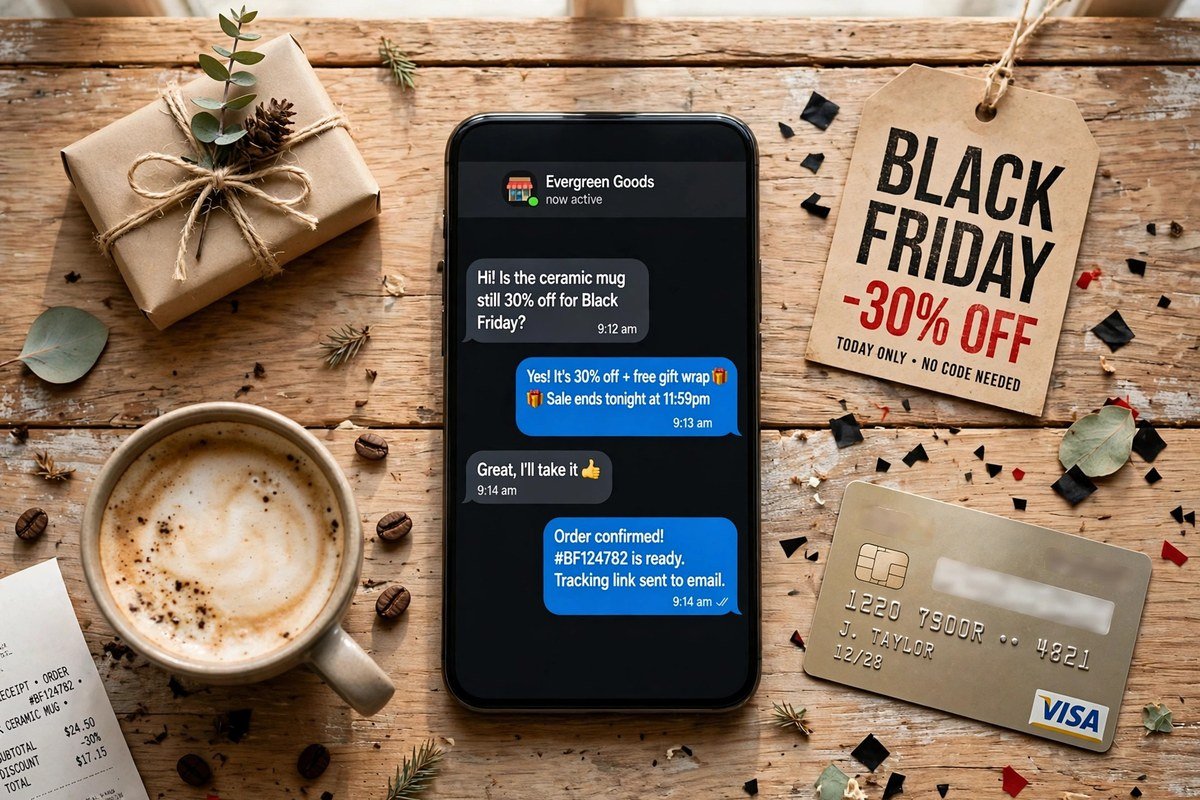
Every marketing text invites a reply, and during sale week the replies arrive in waves right after each send, often in the evening. Most are buying questions: does the code stack, will it arrive by a date, is the size coming back, can I return a sale item. Decide before November who answers, during which hours, and how fast, and write down the answers to the questions you already know. A reply left until Monday is usually a lost sale.
Cart recovery deserves its own plan because the scale is large: the Baymard Institute puts the documented cart abandonment rate at 70.22% across 50 studies, with extra costs the top reason at 40% and slow delivery second at 20%. A short text that names the item and asks whether the shopper needs anything works better than another discount. Timing matters too. In field experiments published in the Journal of Marketing, cart reminders sent 30 minutes to one hour after abandonment lowered purchases compared with no message, while reminders sent one to three days later raised them. In sale week a later reminder may land after the offer ends, so test the delay against your own sale calendar, and answer a question the shopper asked as soon as possible.
How Do You Measure Whether the Texts Paid Off?
Clicks alone will mislead you on Black Friday, because many shoppers would have bought anyway. Measure each campaign on revenue per recipient: the revenue attributed to the send divided by the number of messages delivered. Compare it with the all-in cost per message from the pricing table, and you have the real margin of the campaign. Klaviyo’s BFCM 2025 recap reported that email and text together drove 42% of total revenue across its customers during BFCM, rising to 43% on peak days. Track the click rate by message type and segment so you can drop what did not work before Cyber Monday, watch the opt-out rate per send for a spike that signals wrong copy or timing, and check delivery rate, because a message that never arrives is a list hygiene problem.
Finally, run a holdout. Keep a small random slice of your list out of one campaign and compare their buying with the group that received it. The difference is the closest thing you will get to the true incremental effect of the text, and it stops you crediting SMS for sales that the email or the paid ad would have won anyway. Our guide to measuring digital marketing ROI for small business works through the same attribution problem for the rest of your marketing, and the festive calendar in our festive content calendar for small business keeps the whole season coordinated.
Conclusion
SMS marketing for Black Friday ecommerce rewards restraint more than volume. Four to six well-timed messages to the right segments, each naming the brand, the offer and a real deadline, will earn more revenue and fewer opt-outs than a week of blasts to the whole list. Price the week before you plan it, keep every message inside one 160-character segment, send in the subscriber’s local time, and respect the consent rules in the US and the UK. Do that, and your texts will be the messages customers welcome instead of mute, on Black Friday and on every sale after it. For the wider picture, Klaviyo’s Black Friday SMS marketing strategy guide is a useful second reference for segmentation and timing.
Frequently Asked Questions
How many SMS messages should I send during Black Friday week?
Plan four to six messages across the whole week: a teaser, an early access message for VIPs, a launch text, one midday flash or bundle message, and a last chance, plus a Cyber Monday launch. Nobody should receive all of them. Segment the list, exclude recent buyers from reminders for items they already bought, and stop sending to anyone who opts out.
Is it legal to text customers on Black Friday?
Yes, if you have the right permission. In the US, the TCPA requires express written consent for marketing texts, quiet hours run from 8am to 9pm in the recipient’s local time, and STOP requests must be honoured within ten business days. In the UK, PECR Regulation 22 requires specific consent, with a narrow soft opt-in for your own previous customers about similar products, and an opt-out in every message. Email consent never authorises SMS, and a bought-in list never qualifies.
What time should I send my Black Friday launch text?
Send between 6am and 9am in the subscriber’s local time zone on Friday 27 November 2026. Klaviyo’s 2024 data recorded the highest Black Friday send volume between 9 and 10am Eastern, while order volume peaked from noon to 1pm Eastern. Schedule by the recipient’s time zone, not your own, and keep the send inside the 8am to 9pm quiet-hours window.
How much does SMS marketing for Black Friday ecommerce cost?
For a store with 5,000 subscribers sending four messages in the week, expect about $180 on Klaviyo at $0.009 per credit, or about $246 all in on Postscript Starter at $0.0123 per message including carrier fees. UK sends cost far more: a Twilio text to a UK number is $0.056 per segment against $0.0083 in the US. Keep messages under 160 characters and avoid MMS on the day itself.
Should I send MMS with images on Black Friday?
No, not for time-sensitive messages. MMS costs roughly three times a plain SMS on Klaviyo and $0.045 per message on Postscript Starter against $0.009 for SMS, and carrier networks carry heavy traffic on Black Friday, so image messages are more likely to deliver late. A flash sale text that arrives two hours late is useless. Use plain SMS on the day itself and save images and rich media for email.













1 Comment
[…] through your other channels, and keep the code, end date and minimum spend identical everywhere. SMS marketing for Black Friday works well for this, because a short message can push shoppers to a live promotion on the day it […]