

Learning how to write AI prompts for ad copy that actually converts is less about finding a magic sentence and more about giving the AI a complete brief. Most AI ad copy disappoints because the prompt is vague: “write an ad for my product” leaves the AI guessing about the audience, the offer, the format and the goal, so it fills the gaps with generic lines you could never run.
This guide fixes that. You will learn a simple five part prompt framework, get copy paste example prompts for Google, Meta, LinkedIn and retargeting ads, and learn how to test the output until you have ads worth paying to run.
Why Vague Prompts Produce Generic Ad Copy
An AI tool does not know your customer, your product or your market position unless you tell it. When the prompt is thin, the output leans on clichés: “unlock your potential”, “take your business to the next level”, “don’t miss out”. These lines sound polished and say nothing, and readers scroll straight past them.
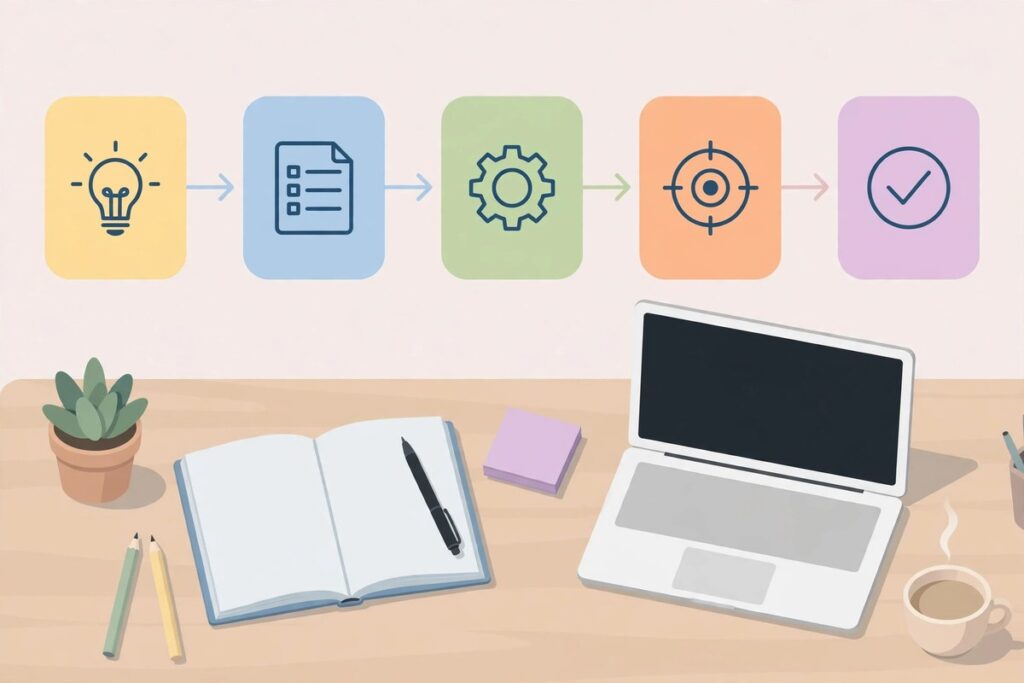
The fix is not a better AI tool. It is a better brief. Every strong ad prompt answers five questions before the AI writes a word: who is speaking, who is listening, what is on offer, what shape the ad must take, and what rules it must follow. Miss one of those and the output drifts. Include all five and the first draft is usually close to usable, needing only a human edit rather than a rewrite.
How to Write AI Prompts for Ad Copy: The 5 Part Framework
Use this framework for every ad prompt you write. Fill in the brackets with your own details and paste the whole block into your AI tool of choice.
| Part | What to include | Example fill in |
|---|---|---|
| 1. Role | The expert you want the AI to act as | Senior direct response copywriter |
| 2. Audience | One specific buyer, with one pain or desire | Busy parents who cook at home five nights a week |
| 3. Offer | The product, the benefit and the action you want | Meal kit subscription, free first box, sign up today |
| 4. Format | Platform, length and structure | Google responsive search ad, 15 headlines of 30 characters max |
| 5. Constraints | Rules that keep the copy honest and on brand | No hype words, no unverified claims, plain UK English |
Here is the framework as one master prompt you can reuse:
Act as a senior direct response copywriter. Write ad copy for [platform] promoting [product] to [audience] who struggle with [pain point]. The main benefit is [benefit] and the offer is [offer]. The goal is [clicks, sign ups or sales]. Give me [number] variations. Headlines must stay under [character limit] and the tone must be [tone]. Do not use hype words, unverified claims or jargon. End each variation with a clear call to action.
The constraints line does more work than most writers expect. Telling the AI what to avoid stops the most common failure modes: inflated promises, invented statistics and a tone that sounds nothing like your brand. If you have two or three lines of copy you love, paste them in as examples too. The AI will match their style far more reliably than it will match an adjective like “punchy”. This matches the five element structure described by Typeface’s guide to AI copywriting prompts, which lists the ad subject, unique selling points, target audience, content goal and tone as the core parts of a good ad prompt.
Copy Paste Prompts for Google Ads
Google search ads are tight. Headlines cap at 30 characters and descriptions at 90, so the prompt must force brevity and force the keyword in. Try this:
Act as a Google Ads copywriter. Write 15 headlines (30 characters max) and 4 descriptions (90 characters max) for a responsive search ad promoting [product] to [audience]. Include the keyword [keyword] in at least 5 headlines. Lead with the main benefit, [benefit], and end each description with a clear call to action. No exclamation marks in every line, no unverified claims.
Ask for 15 headlines even if you only need a few. Google mixes and matches them, and a wider set gives the system more winning combinations to test. When the output arrives, check every character count yourself before uploading, because AI tools regularly overshoot limits by a few characters. Our product page copywriting that converts guide covers the next step: making sure the page the ad sends people to delivers the same promise as the headline, which is where most campaigns quietly lose sales.
Copy Paste Prompts for Meta and Social Ads
Social ads work differently. The first line must stop the scroll, the body must sell one benefit, and the call to action must be obvious. Use this prompt for Facebook and Instagram:
Act as a social media copywriter. Write 3 Facebook ad variations for [offer]. Each variation needs a scroll stopping first line, 2 to 3 lines of body copy with one benefit and one proof point, and a clear call to action. Audience: [audience]. Tone: [tone]. Vary the angle across the three ads: one pain point angle, one benefit angle, one social proof angle. Keep each ad under 125 words.
One angle per ad is the key instruction here. If you let the AI mix pain, benefit and proof into every variation, all three ads end up sounding the same and you learn nothing from testing them. Separate angles give you a real test: after a few days of running, you will know which angle your audience responds to, and that insight is worth more than any single ad.

Copy Paste Prompts for LinkedIn and Retargeting Ads
LinkedIn readers are at work, so the tone should be professional and the value should be concrete. Try this prompt:
Act as a B2B copywriter. Write 3 LinkedIn ad variations for [product or service] targeting [job title] at [company size] companies. Each ad should open with a workplace problem they recognise, present [benefit] as the outcome, and end with a low pressure call to action such as downloading a guide or booking a short demo. Keep the tone professional and direct. No buzzwords.
Retargeting ads speak to people who already visited and left, so the prompt should acknowledge that history. Use this:
Act as a direct response copywriter. Write a retargeting ad for people who visited [landing page] but did not buy. Acknowledge their hesitation in the first line, restate the main benefit, answer the most common objection, [objection], and offer one reason to return now. Keep it friendly, not pushy, and end with a single call to action.
Retargeting is also where your email follow up does heavy lifting alongside ads. Our abandoned cart email sequence examples show how a short sequence recovers shoppers who left without buying, using the same objection handling logic as the retargeting prompt above.
How to Test and Improve AI Ad Copy
Good prompts produce good drafts, not finished ads. Treat the first output as raw material and run a short loop before you spend serious budget:
Generate wide, then narrow. Ask for 10 or more variations, pick the best 3, and ask the AI to rework only those with a tighter constraint, such as a shorter headline or a stronger proof point. Refinement prompts beat fresh prompts once you have a direction you like.
Test one variable at a time. If you change the headline, the image and the offer in the same test, you will never know which change moved the result. Change the headline first, since it carries the most weight, then test the body copy, then the call to action.
Read every line out loud. If a sentence sounds stiff or robotic spoken aloud, it will read worse on a phone screen. Cut filler words, swap abstract nouns for concrete ones, and delete any claim you cannot back up with a real fact about your product.
Keep a prompt library. Save every prompt that produced a winner, with a note about what it produced and where it ran. Over a few months this becomes a genuine asset: a set of proven briefs your whole team can reuse instead of starting from a blank box each time. Our how to measure digital marketing ROI for small business guide explains how to judge whether those winners are actually profitable once you include the costs most owners forget, such as tools, time and content production.

Common Mistakes to Avoid
Writing one prompt for every platform. A Google headline, a Meta caption and a LinkedIn ad are different formats with different limits. Prompt for each format separately or the output will fit none of them.
Skipping the proof. Ads without proof read as opinion. Give the AI one real proof point to use, such as a rating, a guarantee or a customer count, and tell it to place that proof near the call to action.
Letting the AI invent facts. AI tools will happily invent a discount, a statistic or a testimonial if the prompt leaves room for one. Ban invented claims in the constraints line and verify every number in the output before publishing.
Publishing the first draft. Even a great prompt produces a draft. Edit for brand voice, check the character counts, confirm the landing page matches the ad promise, and only then launch. Our newsletter growth strategies for creators guide makes the same point for email: the list and the follow up sequence matter as much as any single piece of copy.
Conclusion: How to Write AI Prompts for Ad Copy That Converts
Knowing how to write AI prompts for ad copy comes down to one habit: brief the AI the way you would brief a good copywriter. Give it a role, one audience, one offer, an exact format and firm constraints, then generate wide, test one variable at a time and keep the prompts that win. Start with the five part framework in this guide, run the Google, Meta, LinkedIn and retargeting prompts for your next campaign, and build your own prompt library from the results. The AI will not replace your judgement, but a well written prompt turns it into the fastest drafting partner you have ever had.
Frequently Asked Questions
What is the best way to start learning how to write AI prompts for ad copy?
Start with the five part framework in this guide: role, audience, offer, format and constraints. Write one prompt for a single ad format, run it, and study which parts of the output worked and which did not. Adjust one part at a time and you will learn faster than by collecting dozens of prompts you never test.
How many ad variations should I ask the AI to write?
Ask for 10 or more in the first round, then narrow to your best 3 for refinement. A wide first round gives you real choice, while refining only the winners keeps the work manageable. For Google responsive search ads, 15 headlines is a sensible ask because the platform tests combinations for you.
Can I use AI generated ad copy without editing it?
No, not safely. AI output regularly overshoots character limits, invents claims and drifts off brand. Always check the facts, tighten the wording, confirm the tone matches your brand, and make sure the landing page delivers the same promise as the ad before anything goes live.
How do I keep AI ad copy on brand?
Paste one or two lines of your best existing copy into the prompt as style examples, and state the tone and the banned words in the constraints line. Examples guide the AI far more reliably than adjectives. Review the first few outputs against your brand voice and add any recurring error to the constraints for next time.
Which ad format should I prompt for first if my budget is small?
Start with the format where your buyers already spend time and where you can test cheapest. For most small businesses that means one social platform with a single clear offer, plus a retargeting ad for visitors who did not convert. Prove one angle there before spreading budget across more formats.