


Retargeting ad frequency best practices start with one uncomfortable truth: most advertisers either show the same ad until people hate it, or show it so rarely that nobody remembers the brand. Both mistakes cost money, and both are avoidable once you set caps deliberately instead of accepting platform defaults. This guide gives you one reconciled set of caps, the exact settings to change in Google Ads, Meta and LinkedIn, and a weekly routine that catches fatigue before it eats your budget.
Retargeting works because the audience already knows you. Someone visited your site, watched your video or abandoned a cart, so the ad is a reminder, not a cold introduction. That familiarity is also why frequency matters more here than in prospecting. A stranger can tolerate repetition while they learn who you are. A warm visitor who has already decided, or already bought, experiences the tenth identical ad as nagging, not persuasion.

Retargeting Ad Frequency Best Practices: Frequency, Capping and Recency
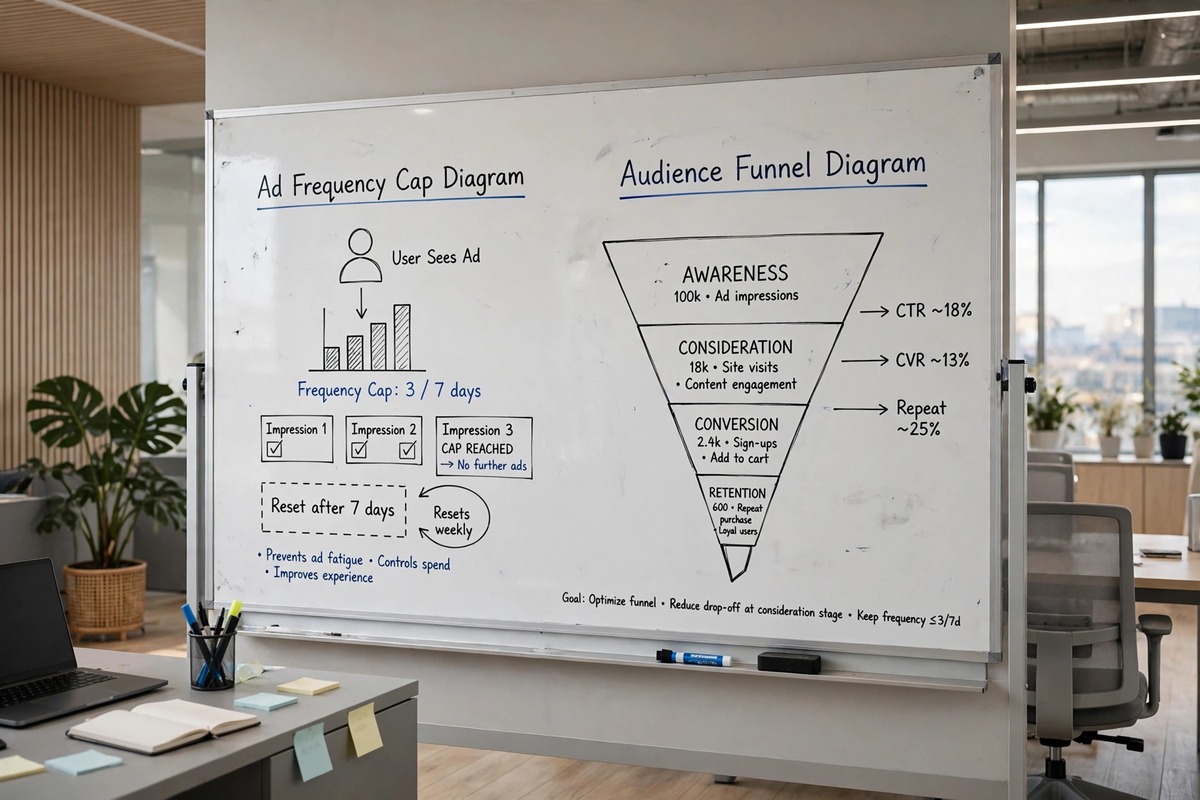
Advertisers use these terms loosely, and the confusion causes real mistakes. Frequency is simply how many times one person sees your ads in a set period, usually expressed as impressions per person per week. Frequency capping is the limit you set on that number. Recency capping is different: it sets the minimum gap between exposures, so a person cannot see your ad three times in one hour even if the weekly cap is still unmet.
You need both caps. A weekly cap of 7 sounds restrained, but if all 7 impressions land on Monday morning, the user still feels stalked. A recency rule, such as no more than 2 impressions per day and at least 4 hours between them, spreads the same total across the week and protects the brand while the cap does the long term work. Google Ads makes the distinction explicit: its help page defines frequency capping as a limit on how many times Display or Video ads appear to the same person, set per day, week or month, at campaign, ad group or ad level.
One Reconciled Benchmark Table: Caps by Funnel Stage and Platform
Rival guides disagree with each other, sometimes wildly. One quotes cart abandoners at 5 to 8 impressions a week, another at 2 a day, which is 14 a week. The table below reconciles those contradictions into a single starting point. It leans toward the lower end of each range, because it is cheaper to raise a cap that under-delivers than to repair the annoyance a high cap causes. Treat these as starting values for a two week test, not as permanent law.
| Audience | Google Display | Meta (Facebook and Instagram) | Window | |
|---|---|---|---|---|
| Cart or checkout abandoners | 2 per day, 8 per week | 2 per day, 10 per week | Not usually applicable | 7 to 14 days |
| Product or service page visitors | 1 to 2 per day, 5 to 7 per week | 1 to 2 per day, 7 per week | 2 to 3 per week | 14 to 30 days |
| Blog readers and video viewers | 1 per day, 3 to 5 per week | 1 per day, 3 to 5 per week | 1 to 2 per week | 30 days |
| Past buyers (cross sell only) | 1 per day, 3 per week | 1 per day, 3 per week | 1 per week | 30 to 60 days |
| Warm B2B audiences | 1 per day, 5 per week | 1 per day, 5 per week | 2 to 3 per week | 30 to 90 days |
Two patterns sit behind the table. First, intent sets the cap: the closer someone is to buying, the more impressions they can tolerate, because each ad answers a live question rather than interrupting a stranger. Second, LinkedIn caps run lower because its audience is smaller, its costs are higher, and the same professionals see your ads in a work context where repetition feels intrusive faster. On every platform, start low, watch the fatigue signals below, and raise the cap only when performance is stable and complaints are absent.
How to Set Frequency Caps in Google Ads, Meta and LinkedIn
Google Ads Display. Open the campaign, go to Settings, then Additional settings, and find Frequency capping. Set impressions per day, per week or per month at campaign, ad group or ad level. For retargeting, set the cap at the ad group level so each audience segment carries its own number, and use the table above as your first values. For Video campaigns, the cap applies at campaign level only, and it counts views as well as impressions, so check both numbers when you review.
Meta Ads Manager. Meta does not offer a simple global frequency cap on every campaign type, so control it in three places. First, choose the Reach objective or set a frequency control where the campaign type offers one, and cap at roughly 2 impressions per person per day for retargeting. Second, set a daily budget that cannot physically buy excessive repetition for a small audience: budget divided by audience size is your real cap. Third, watch the Frequency column in Ads Manager weekly, and if it climbs past your target, lower the budget or narrow the window rather than adding more creative.
LinkedIn Campaign Manager. LinkedIn has no direct frequency cap setting on most campaign types, so frequency is managed through budget, audience size and rotation. Keep daily budgets modest relative to audience size, rotate at least three creatives, and check the frequency metric in Campaign Manager. If frequency passes 3 in a week for a small professional audience, pause the weakest creative and tighten the audience rather than raising spend. Our guide to startup marketing budget breakdown shows how to size a test budget from customer value first, which is exactly the discipline that stops a small audience being bought out in days.

Recency Capping: The Gap Between Exposures Matters as Much as the Total
Recency rules are the most neglected part of retargeting ad frequency best practices, and rivals barely mention them. A practical starting point: no more than 2 impressions per person per day, no two impressions within the same browsing session where the platform allows that control, and a pause of at least 24 hours after a click that did not convert. The last rule matters because a clicker who did not buy needs a different message, not the same ad again tomorrow morning.
Sequence your creative by recency as well. Days 1 to 3 after the visit: the reminder, showing the product or service they viewed. Days 4 to 10: the objection answer, such as delivery, returns or a testimonial. Days 11 to 30: the final nudge, such as a limited offer or a different angle entirely. After day 30, move the person to a low frequency brand list or drop them. Retargeting someone for 180 days with the same creative is not persistence, it is the digital equivalent of following them around a shop.
Exclusions and Small Audience Rules: Who Should Never See the Ad
Caps protect people who should see your ads. Exclusions protect people who should not see them at all, and missing exclusions is the fastest way to waste a retargeting budget.
Always exclude: people who already converted, existing customers for the product they just bought, your own employees, job seekers who visited your careers page, and anyone who unsubscribed or complained. On Meta, build these as custom audience exclusions. On Google Ads, add them as audience exclusions at campaign level. Review the exclusion lists monthly, because a converter list that stopped updating will keep advertising a product to people who already own it.
Small audiences need tighter caps, not looser ones. If your retargeting pool is under 1,000 people, a weekly cap of 7 means the same few hundred people see you constantly, because the platform has nowhere else to spend. For pools under 1,000, halve the table values above, widen the window, and add more creative variants so repetition at least looks different. If the pool is under 500, consider email or organic follow-up instead of paid retargeting: the channel is too small for the tool, and the annoyance risk outweighs the return.
Creative rotation is part of frequency control. Refresh creative every 3 to 5 exposures per person as a rule of thumb, and sooner for cart abandoners who see ads daily. Rotation does not raise the cap, it makes the cap survivable. Three genuinely different angles, a benefit angle, a proof angle and an offer angle, will outperform ten versions of the same headline.
The Fatigue Diagnosis Checklist and the 15 Minute Weekly Review
Falling click through rate alone does not prove fatigue. Judge it by combinations, and act on the combination, not on a single metric.
| What you see | What it means | What to do |
|---|---|---|
| CTR down, cost per acquisition up, frequency rising | Classic fatigue: same people, same ad, too often | Lower the cap first, then rotate creative |
| CTR down, cost per acquisition stable, frequency stable | Creative wear-out, not overexposure | Refresh creative, keep the cap |
| CTR stable, cost per acquisition up, frequency rising | Audience exhausted or too small for the budget | Widen the window, add exclusions, or cut budget |
| Negative comments or hides rising | Brand damage, regardless of metrics | Pause the ad set immediately, fix exclusions, then relaunch lower |
| Conversions down after a cap increase | You crossed the annoyance threshold | Return to the previous cap and hold for two weeks |
The 15 minute weekly review. Minutes 1 to 3: check frequency per ad set against the table. Minutes 4 to 7: check CTR and cost per acquisition against the prior two weeks, and flag any ad set where both moved the wrong way. Minutes 8 to 11: read comments and hide rates on the top two ad sets by spend. Minutes 12 to 15: make exactly one change per flagged ad set, cap, creative or exclusion, and write it down. One change at a time is what makes next week’s review meaningful: change three things at once and you will never know which one worked. Pair this with the measurement discipline in our guide to measuring digital marketing ROI for small business, so fatigue is judged on revenue per pound, not on clicks alone.
Small budgets need this routine most. A large advertiser can absorb a week of fatigue across dozens of ad sets. A small business running two retargeting ad sets can lose a month of budget to one tired audience, so the weekly check is not admin, it is the campaign. Retargeted visitors also land somewhere, so make sure the page earns the click: our product page copywriting formula turns that second visit into a sale with outcome-led headlines and objection busters placed where doubts live. And remember the channel you own: a newsletter growth strategy gives you a direct line to warm visitors that no frequency cap can throttle, which is the cheapest fatigue insurance of all.
Conclusion
Retargeting ad frequency best practices come down to five decisions: a cap per funnel stage, a recency gap between exposures, an exclusion list that is actually maintained, creative rotation every few exposures, and a weekly review that acts on metric combinations rather than single numbers. Start with the table in this guide, set the caps in the platform settings rather than trusting defaults, and let two weeks of your own data replace these starting values. The advertisers who win at retargeting are not the ones who show up most. They are the ones who show up at the right moment, with a fresh angle, and then know when to stop.
Frequently Asked Questions
What is a good retargeting ad frequency per week?
For most small businesses, start at 5 to 7 impressions per person per week for product visitors, 8 to 10 for cart abandoners over a short 7 to 14 day window, and 3 to 5 for colder audiences such as blog readers. Test for two weeks, watch click through rate and cost per acquisition together, and adjust one variable at a time.
What is the difference between frequency capping and recency capping?
Frequency capping limits the total number of times one person sees your ads in a period, such as 7 per week. Recency capping sets the minimum gap between exposures, such as no more than 2 per day or at least 4 hours apart. You need both: a weekly cap alone still allows all 7 impressions to land on Monday morning.
How do I set a frequency cap in Google Ads?
Open the campaign, go to Settings, then Additional settings, and find Frequency capping. You can set impressions per day, week or month at campaign, ad group or ad level for Display campaigns. Video campaign caps apply at campaign level only and count views as well as impressions. Google’s own help page confirms these options.
How do I know when retargeting ad fatigue has set in?
Look for combinations, not single metrics: falling click through rate plus rising cost per acquisition plus rising frequency is classic fatigue. Falling click through rate alone with stable costs usually means creative wear-out instead. Rising hides or negative comments mean brand damage, and that ad set should be paused immediately whatever the other numbers say.
Should I exclude existing customers from retargeting campaigns?
Yes, unless the campaign is specifically a cross sell for a different product. Exclude converters, existing customers for the product they bought, employees, careers page visitors and anyone who complained. An exclusion list that is not maintained is the most common reason retargeting budgets are wasted on people who will never buy again.