

A social media crisis management plan for brands is the document you want finished long before you need it. One unhappy customer video, one badly worded post from an employee, or one product fault caught on camera can travel further in an hour than a year of careful marketing. Brands that survive those moments are rarely luckier than the ones that do not. They are simply prepared, with roles agreed, templates written and a response timeline everyone understands.
This guide builds that plan for you, step by step. It covers how to grade a crisis, who does what in the first hour, what to say and what never to say, and how to rebuild trust once the storm passes. It works for small teams as well as large ones, because every section scales down to the people you actually have.
What Counts as a Social Media Crisis for Brands?
Not every negative comment is a crisis. Treating every complaint like an emergency exhausts your team and trains your audience to expect panic. A useful plan grades incidents first, then matches the response to the grade.
| Level | What It Looks Like | Response |
|---|---|---|
| 1. Routine complaint | One customer, one bad experience, low reach | Acknowledge publicly, resolve privately, same day |
| 2. Recurring sentiment | Several customers raising the same issue | Investigate the root cause, post a holding reply, fix the issue |
| 3. Coordinated criticism | Organised groups targeting the brand | Do not engage with every attacker, post one calm factual statement |
| 4. Viral backlash | One incident spreading fast across platforms | Activate the full crisis team, pause scheduled posts, publish a statement |
| 5. Media-amplified crisis | Journalists covering the story | PR leads, legal reviews every statement, daily updates |
Write these levels into your plan with real examples from your own industry, so nobody has to debate the grade while a post is going viral. The grade decides how many people get involved and how fast you move.
Build the Plan Before You Need It: Team, Monitoring and Templates
A social media crisis management plan for brands stands on three legs. Remove any one of them and the plan wobbles exactly when pressure is highest.
First, name the team. You need a crisis lead who makes decisions, a social media manager who posts and monitors, a customer support contact who handles private resolutions, a PR or communications lead for media, and a legal reviewer for sensitive statements. In a small business, one person may wear two hats, but every role still needs a named backup. If the only person with the passwords is on holiday, the plan has already failed. Sprout Social’s crisis management guide recommends exactly this structure, including contact details and backups for every role, plus an approval workflow so no crisis post goes out unreviewed.
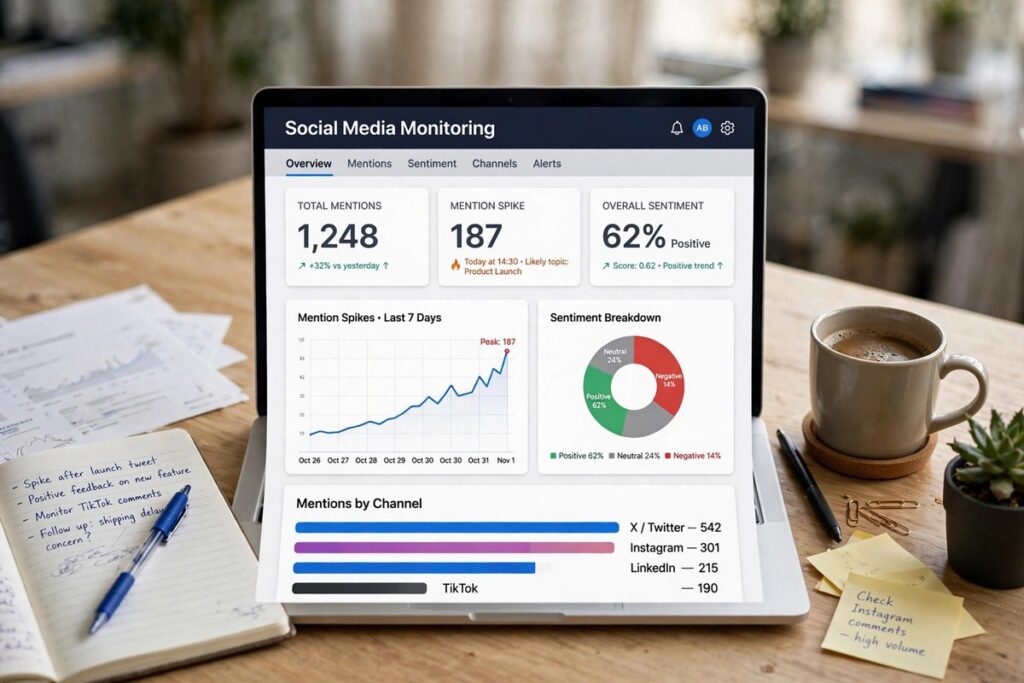
Second, set up monitoring. You cannot respond to a crisis you have not seen. Track direct mentions, untagged brand name mentions, product names and common misspellings, key executives’ names, and complaint terms combined with your brand name. Spike alerts, a sudden jump in mentions or negative sentiment, are the early warning system. The brands that catch a problem in its first hour are the ones that keep a level 2 problem from becoming a level 4 crisis.
Third, write templates now. Pre-approved wording removes the hardest part of crisis response: finding calm, accurate words under pressure. Prepare three templates: an acknowledgement, an update, and a resolution. Each one should have blanks for the facts, never for the tone. The tone is always calm, specific and human.
The First 60 Minutes: A Timeline That Works
Speed matters, but speed without accuracy creates a second crisis. Sprout Social reports that 73 percent of social media users expect brands to respond within 24 hours, which means silence is not an option, yet a rushed statement full of errors is worse than a careful holding reply. Use this timeline:
Minutes 0 to 15: Assess. Confirm what happened, whether it is factually accurate, who is affected, and how widely it is spreading. Screenshot the original post and the key replies before anything gets deleted or edited.
Minutes 15 to 30: Activate. Alert the crisis lead and the relevant team members. Grade the crisis using your five levels. Decide who speaks and on which channels.
Minutes 30 to 60: Pause and acknowledge. Pause all scheduled posts immediately. Nothing looks worse than a cheerful promotion landing in the middle of a backlash. Then publish your acknowledgement template on the channels where the conversation is happening: what you know, what you are doing, and when you will update.
Hours 1 to 2: Publish the full statement. Once the facts are confirmed, publish a proper statement on all relevant channels at the same time, and pin it or link it from your profile. Then hold the line: answer individual comments with empathy and direct people to the statement, rather than debating details in threads.
Writing a Statement That Helps Instead of Hurting
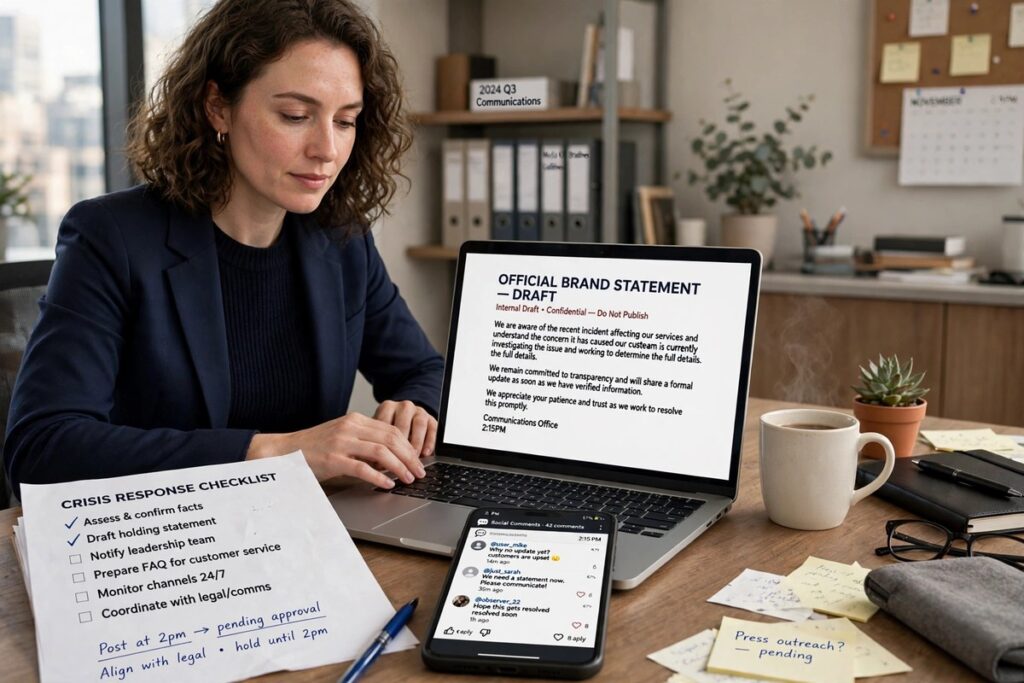
A good crisis statement has four parts. An acknowledgement of the situation, concern for the people affected, the concrete action you are taking, and a clear place to get updates. Leave any part out and the statement feels hollow.
Here is a template you can adapt: “We are aware of [brief description of the issue] and we understand why this matters to [affected group]. We are [specific action being taken] and we will share an update by [time]. If you are affected, please contact us at [channel] and we will help directly.” Notice what it does not do. It does not blame customers, it does not hide behind passive language, and it does not promise what you cannot deliver.
Be careful with apologies. A sincere apology for a real mistake builds trust. A blanket apology for something you did not do can create legal and factual problems, which is why legal review matters at levels 4 and 5. When in doubt, acknowledge the concern and the impact, state the facts you know, and describe the action, even while the full investigation continues.
What Never to Do During a Social Media Crisis
Do not delete comments or block critics. Deletion is almost always screenshotted and reposted, and it turns a complaint into a story about censorship. The only comments worth removing are spam, abuse and hate speech, under your published community policy.
Do not argue in the replies. Even when a critic is factually wrong, a defensive public argument makes the brand look worse to every silent reader. Correct facts calmly once, in the official statement, and move individual cases to private channels.
Do not go silent. Silence reads as indifference or guilt, and it leaves the rumour mill to fill the gap. A short holding reply buys you time honestly: you are aware, you are investigating, and you will update by a stated time.
Do not let scheduled content run. Pause the queue in the first hour. A tone-deaf scheduled post during a crisis becomes a screenshot that outlives the original problem.
Do not improvise the facts. Never guess at causes, numbers or timelines in public. Say what you know, say what you are checking, and give the time of your next update. Accuracy beats speed once the holding reply is out.
Recovery: Rebuilding Trust After the Storm
A crisis ends, but trust recovers on a slower clock. Plan the recovery with the same discipline as the response. First, publish a resolution update that says what changed, not just that the issue is closed. Customers forgive mistakes far more readily when they can see a fix.
Second, measure the damage properly. Track sentiment, mention volume, follower change and, most importantly, business impact. Our guide to measuring digital marketing ROI for small business shows how to separate vanity numbers from revenue reality, which is exactly the discipline a post-crisis review needs.
Third, fix the pages people land on. Crisis traffic often flows to your product and landing pages, so weak copy there wastes the attention. Our product page copywriting formula turns that scrutiny into confidence with outcome-led headlines and objection busters placed where doubts live.
Fourth, rebuild on channels you own. Social reach can vanish with one algorithm change, but an email list stays yours. A newsletter growth strategy gives you a direct line to your most loyal audience, which is the audience that defends you when the next storm arrives. Pair that with a strong SEO content strategy so that your own clear, factual account of the issue ranks above rumour and speculation.
Finally, run the post-crisis review within two weeks. What caused the crisis, could it have been prevented, how fast was the response, and what changes to the plan follow? Update the plan with the answers, and run a simulation before the next real test. A plan that is never rehearsed is a draft, not a plan.

Conclusion
A social media crisis management plan for brands is not a document for bad days, it is a competitive advantage. Teams with agreed roles, a severity scale, monitoring alerts and ready templates respond in minutes while unprepared brands spend those minutes arguing about who should post. Build the plan now, rehearse it once, and review it after every incident. When the viral backlash arrives, and for most brands it eventually does, you will be the brand that handled it with calm, speed and honesty, and that is the reputation that survives.
Frequently Asked Questions
What should a social media crisis management plan for brands include?
At minimum: a named crisis team with backups, a five-level severity scale, monitoring and spike alerts, an approval workflow, three pre-written templates (acknowledgement, update, resolution), a pause procedure for scheduled posts, and a post-crisis review process. Small teams can cover all of this in a few pages.
How fast should a brand respond to a social media crisis?
Publish a holding acknowledgement within the first hour, and a fuller statement within 1 to 2 hours once facts are confirmed. Sprout Social reports that 73 percent of users expect a response within 24 hours, so same-day acknowledgement is the floor, not the goal.
Should brands delete negative comments during a crisis?
No, except for spam, abuse and hate speech under a published community policy. Deleting genuine criticism is usually screenshotted and reposted, turning a complaint into a second story about censorship. Acknowledge publicly and resolve privately instead.
How is a viral backlash different from a routine complaint?
Scale and speed. A routine complaint involves one customer and low reach, and it is handled by support. A viral backlash spreads across platforms, attracts media attention, and needs the full crisis team, paused scheduled content, and a public statement. Your severity scale is what tells you which one you are facing.
How do brands rebuild trust after a social media crisis?
Publish a resolution update showing what actually changed, measure business impact rather than vanity metrics, fix the pages crisis traffic lands on, invest in owned channels like email, and run a post-crisis review within two weeks that updates the plan. Trust returns when customers see action, not just apology.